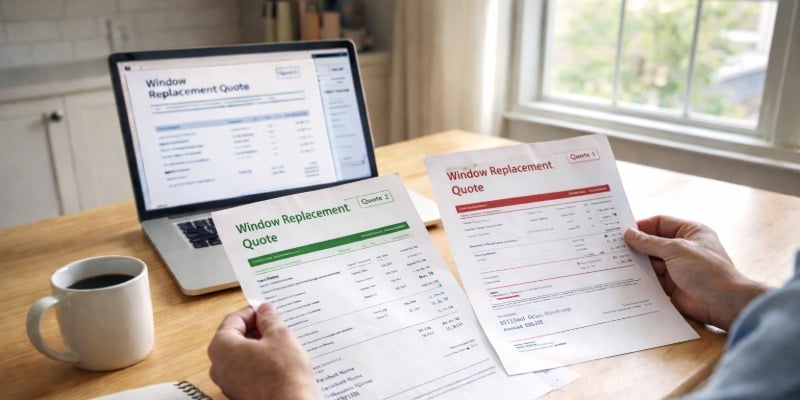
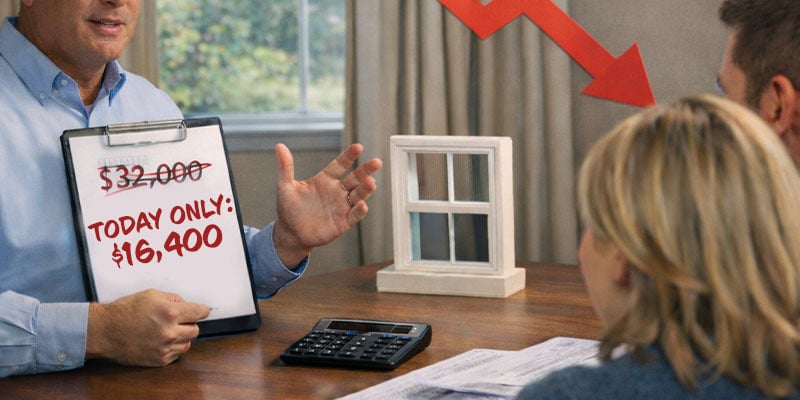
If you’ve ever watched a $32,000 window quote drop to $12,400 in 45 minutes, you’re not crazy for feeling confused.
For many homeowners in Westmoreland County and the Greater Pittsburgh area, the most uncomfortable part of replacing windows isn’t the cost, it’s the sales process. Prices shift. Discounts appear. Urgency increases. And it can be hard to tell what’s real and what’s strategy.
Since 1999, Energy Swing Windows & Doors has met with thousands of homeowners throughout the Greater Pittsburgh area who felt pressured, overwhelmed, or unsure whether they were getting a fair deal.
And to be clear, not every window company uses aggressive tactics. Many operate with integrity. But certain pricing and presentation strategies are common in the industry, and understanding them can make a big difference.
By the end of this article, you’ll know exactly why quotes change, how pricing is structured, and what questions prevent pressure before it starts.
If you’re gathering estimates now or planning to soon, this guide will help you walk into those appointments prepared and confident.
Why We Encourage You to Read This Before Meeting With Any Window or Door Company
If you’re scheduling estimates this week, or already have one booked, take 5 minutes and read this article first.
We actually send this article to homeowners before we meet because we want you to understand how pricing works before anyone sits at your kitchen table.
Once you understand how pricing is often structured, how discounts are framed, and what questions shift the conversation, the entire experience feels different.
You won’t feel rushed.
You won’t feel confused.
And you’ll recognize pressure immediately if it appears.
Why Do Window Quotes Change So Dramatically During Estimates?
One of the biggest frustrations homeowners express is how dramatically prices can change during an appointment.
In competitive markets like Pittsburgh, especially during busy spring and fall seasons, pricing strategies can become more aggressive.
It’s not unusual to see a project start at one number and then suddenly drop because of high-pressure sales tactics like:
-
“Manager discounts”
-
“Job sign discounts”
-
“Today-only savings”
-
“Special financing adjustments”
Before you know it, a $32,000 project becomes $16,400… but only if you sign today.
While occasional manufacturer rebates happen, dramatic same-day price drops often indicate pricing was intentionally inflated to create negotiating room.
Why Pricing Starts to Feel Unstable
When pricing moves that quickly, it naturally raises questions:
- Am I getting the same window?
- Did something change?
- Was the first number real?
- How do I know this is the final price?
And when the entire process becomes confusing and uncomfortable, that’s usually the real issue, not the windows themselves.
What Really Impacts Window Replacement Cost: Product vs Installation
A strong presentation often focuses heavily on product features such as glass packages, lock systems, frame materials, and performance demos. Those things do matter.
But what’s often under-discussed is how the window will actually be installed into your home.
Every project really has four parts:
-
The product itself
-
The installation process
-
How the product integrates with your home’s structure
Many sales reps spend the majority of their time discussing the product and very little explaining the installation details. But long-term performance depends just as much, if not more, on how that window is installed.
Over the next 20–30 years, installation quality will impact energy efficiency, durability, and overall satisfaction far more than a flashy demo ever could.
The “Good, Better, Best” Window Pricing Strategy Explained
When the salesperson lays out three options side-by-side, this is usually the moment most homeowners start trying to “read between the lines.”
Many window companies present options in three tiers:
|
Option |
Typical Positioning |
|
Good |
Entry-level option |
|
Better |
Mid-tier (most commonly sold) |
|
Best |
Premium or high-end option |
At first glance, this structure feels helpful. It gives you a clear framework and makes the decision seem simpler.
But there’s psychology behind it.
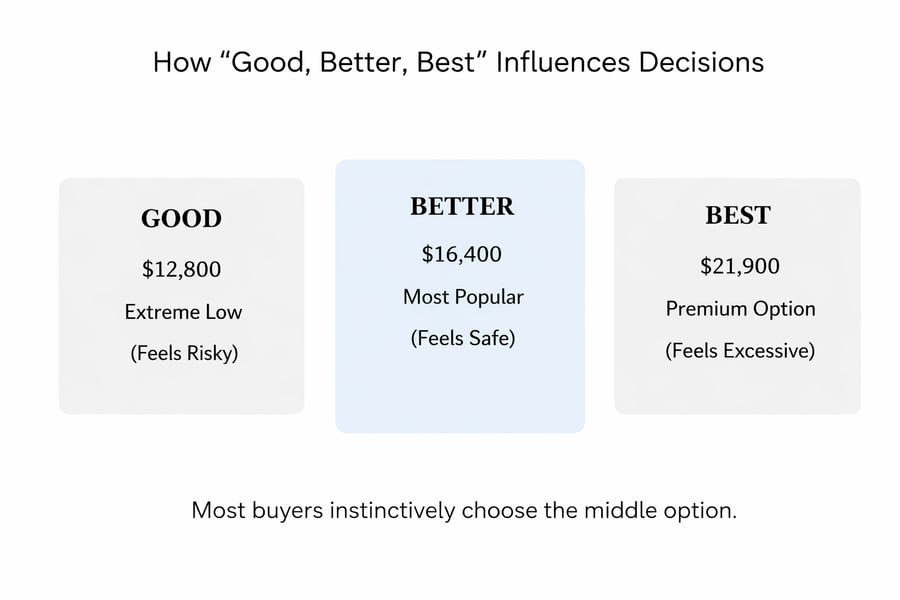
When three options are presented side by side, most homeowners instinctively avoid the extremes. The lowest tier can feel risky. The highest tier can feel excessive. That makes the middle option feel safe and reasonable even before you’ve fully broken down what’s included.
Behavioral economics research shows consumers often gravitate toward middle-tier options when presented with three choices. This tendency is called the “Middle-Option Bias" or "The Decoy Effect.” When presented with three choices, most buyers avoid the lowest and highest options, even before fully comparing details.
The difference between tiers isn’t always just product quality, it might also be installation methods.
Sometimes what changes includes:
-
The number of windows included
-
Stock vs custom sizes windows
-
Installation scope
-
Interior trim work
-
Exterior capping
-
Glass package upgrades
In other words, you may not be comparing three versions of the same project. You may be comparing three completely different scopes of work.
How to Evaluate “Good, Better, Best” Pricing Options
Instead of focusing on the labels (“Good,” “Better,” “Best”), try reframing the conversation around three things:
-
Product quality – Is the actual window different?
-
Installation method – Is more labor or trim work included?
-
Project size – Are more windows being added?
Then ask directly:
“Is the price difference based on product quality, installation scope, or total number of windows?”
That single question often shifts the conversation from presentation to transparency and helps you evaluate the project based on facts instead of framing.
Why Window and Door Companies Focus on Monthly Payments Instead of Total Cost
Reducing a large project to a smaller monthly number makes it feel more manageable.
For example, $18,000 feels big.
$300 per month feels doable.
But $300 per month for 60 months is still $18,000.
Why Monthly Payments Can Be Misleading
|
Sounds Like |
Actually Means |
|
$300/month |
$18,000 over 60 months |
|
0% financing |
Interest cost often built into project price |
|
“Affordable” |
Based on payment, not total investment |
In some long-term 0% financing programs, the cost of offering that financing is built into the project price. Many homeowners don’t realize that lenders often charge contractors 20–25% to provide extended 0% terms, and that cost can be factored into your total.
Financing can absolutely make sense. But before focusing on payments, it’s important to understand:
-
Total project cost
-
Total repayment amount
-
Fees built into financing or early payoff penalties
-
Whether a shorter same-as-cash option exists
Affordability matters. But clarity matters just as much.
How Long Does Window and Door Replacement Take in Pittsburgh?
In a competitive market like Pittsburgh, speed can win jobs.
If most companies are quoting 10–12 weeks and one promises 6–8 weeks, that shorter timeline can feel like an easy decision, especially if you have an event coming up or simply want the project done quickly.
However, many local contractors order from the same manufacturers. That means production timelines are often similar across companies.
If you want a full timeline breakdown from consultation to installation, read this article on how long it really takes to get a custom entry door.
Typical Window & Door Lead Times in Western Pennsylvania
|
Product Type |
Typical Lead Time |
What Affects Timing? |
|
Standard Vinyl Replacement Windows |
6–10 Weeks |
Seasonality (spring and summer often extend timelines), manufacturer backlog |
|
Premium or Custom Windows |
8–12+ Weeks |
Custom colors, specialty glass packages, unique sizing |
|
Sliding or Hinged Patio Doors |
8–12 Weeks |
Size, configuration, and glass upgrades |
|
Custom Entry Doors |
10–14+ Weeks |
Decorative glass, stain finishes, sidelites, hardware selection, custom sizing |
|
In-Stock / Builder-Grade Products |
2–6 Weeks |
Limited styles and sizing; dependent on current inventory |
That doesn’t mean every faster timeline is misleading. But if one estimate is dramatically shorter than the others, it’s worth asking:
-
Is this timeline confirmed by the manufacturer?
-
Is the product in stock?
-
What happens if delays occur?
A transparent contractor will set realistic expectations even if that means quoting a slightly longer timeline upfront.
Should Window Replacement Quotes Be Itemized?
Most estimates are presented as a single lump-sum number. While that keeps things simple on paper, it makes it difficult to understand:
-
Cost per window
-
Cost of upgrades
-
What’s included vs. assumed
Promotions like “Buy Two, Get Two Free” are often bundled together without clear itemization. Or, you’re told the windows are “FREE” but then charge you an inflated installation price.
Transparent pricing, on the other hand, should clearly outline:
-
Product details
-
Installation scope (interior and exterior work)
-
Warranty coverage
-
Who is responsible for service
-
Labor coverage duration
The more clearly everything is defined, the easier it is to compare options confidently.
Are Window Sales Presentations Scripted or Pre-Planned?
In many cases, yes.
Because most windows operate similarly, companies often differentiate themselves through storytelling. Whether that’s focusing heavily on lock systems, material strength comparisons, or dramatic glass demonstrations.
Small sample windows shown at a kitchen table will always operate smoothly. But a full-sized window installed in your home carries more weight and complexity.
It’s common for salesmen to be trained to “sell” to you, not actually develop the best solution for your situation. Even if a presentation can feel polished and impressive, it’s important to ask:
How will this perform in my actual window opening, in my home, over time?
3 Questions to Ask During a Window Replacement Estimate
These questions often shift the conversation from presentation to transparency.
-
Can I see a copy of the warranty in writing?
-
What is the per-window cost?
-
I’m not making a decision today, is that okay?
Warranties especially deserve attention.
The word “lifetime,” for example, can mean very different things depending on the company. One warranty may cover only the replacement product. Another may cover product, labor, and service.
Without reading the fine print, two “lifetime” warranties can be completely different.
What Does “Premium” and “Top-Tier” Really Mean for Windows?
Words like “premium,” “top-tier,” and “industry-leading” sound reassuring. But they’re all relative terms.
A lower-grade product can still be marketed as premium, it just depends on who you ask. Instead of relying on adjectives, ask for measurable details:
-
U-factor
-
Air infiltration rating
-
Installation method
-
Written service policies
Clear metrics provide far more confidence than strong marketing language.
What Should a Transparent Window Estimate Include?
A transparent consultation typically starts with questions about your goals. It balances discussion of product and installation. It explains warranty specifics clearly and puts everything in writing.
It also respects your timeline.
Not every homeowner is the right fit for every company, and that’s okay. The focus should be on how the product and installation system will perform on your home for the next 20–30 years, not just how smooth a sample window slides on a table.
Transparent Window Consultation Checklist
-
Starts with questions about your goals
-
Discusses both product and installation equally
-
Explains warranty specifics in writing
-
Is comfortable with you taking time to decide
-
Acknowledges that not every homeowner is the right fit
How to Choose a Pittsburgh Window Company Without Sales Pressure
Knowing what can happen removes the surprise.
When you understand how pricing and presentation strategies work, the experience becomes less intimidating.
Homeowners who educate themselves ahead of appointments often recognize tactics immediately. In fact, some have read about common sales strategies and then experienced them word-for-word in their first consultation
That awareness changes everything, and instead of feeling pressured, you feel prepared. Instead of focusing on price drops, you focus on value.
What to Look for in a Transparent Window Company
When evaluating contractors in Pittsburgh or Western Pennsylvania, look for:
- Clear, written pricing breakdowns
- Detailed installation explanations
- Warranty coverage in writing
- Realistic lead times
- Comfort with you taking time to decide
If you feel informed instead of pressured, that’s a good sign.
Next Steps Before Scheduling Your Pittsburgh Window Estimate
Replacing your windows is a 20–30 year investment. And when pricing shifts dramatically during an appointment, it’s natural to feel uneasy.
Now you understand why quotes can change, how discounts are sometimes structured, and which questions bring clarity back into the conversation. When you recognize how pricing psychology works, the pressure loses its power.
Since 1999, Energy Swing Windows and Doors has built our consultation process around education first. That means clear pricing in writing, a full explanation of installation methods, warranty details you can review at your own pace, and no expectation that you make a decision on the spot.
If you’re ready for a consultation designed to inform rather than pressure, you can schedule one here.
And no matter who you choose, we hope this guide helps you walk into every estimate feeling confident and in control.
Because the right company won’t rush your decision. They’ll earn it.
Frequently Asked Questions About Window Sales Tactics
1. Why do window replacement quotes change so much during the appointment?
Window quotes often change because some companies use what’s called presentation pricing — starting high to create room for discounts later.
This can include:
- Manager approval discounts
- Same-day signing incentives
- Financing adjustments
- “Today only” promotions
While manufacturer rebates do exist, dramatic price drops during a single appointment can indicate the original number included built-in negotiation room.
2. Are all window companies using high-pressure sales tactics?
No. Many reputable contractors use transparent, fixed pricing models.
However, the in-home remodeling industry has historically relied on structured presentations and urgency-based discounting. That’s why it’s important to ask clear questions and understand how pricing is structured before making a decision.
A transparent company will:
- Put pricing in writing
- Allow you time to decide
- Clearly explain installation and warranty details
3. Is it normal for window sales reps to require a decision the same day?
It’s common, but not required.
Some companies structure pricing around same-day discounts, meaning if you don’t sign during the appointment, the price increases.
If you’re told pricing is only valid “today,” ask:
- Is this tied to a manufacturer rebate?
- Is the base price different tomorrow?
- Can I see pricing without the same-day discount?
A contractor confident in their value should be comfortable giving you time to think.
4. What’s the difference between product cost and installation cost in window replacement?
Every window project includes two major components:
- The window itself
- The installation process
While product features like glass packages and frame materials matter, installation quality often has a greater impact on long-term performance.
Poor installation can lead to:
- Air leakage
- Water intrusion
- Premature seal failure
- Warranty issues
Always ask how the window will be installed, not just what the window is made of.
5. Why do window companies focus on monthly payments instead of total cost?
Monthly payments make large projects feel more manageable.
For example:
- $18,000 sounds large
- $300 per month feels smaller
But over 60 months, that’s still $18,000 — sometimes more if financing costs are built into the price.
Before agreeing to financing, clarify:
- Total project cost
- Total repayment amount
- Whether financing fees are included in the contract price
6. Are “Good, Better, Best” window options legitimate?
Yes — but they should be clearly defined.
The issue isn’t having three options. The issue is whether you’re comparing:
- Different products
- Different installation scopes
- Different numbers of windows
If the scope changes between tiers, you may not be comparing the same project.
Ask directly:
Is the price difference based on product quality, installation method, or project size?
Topics: